
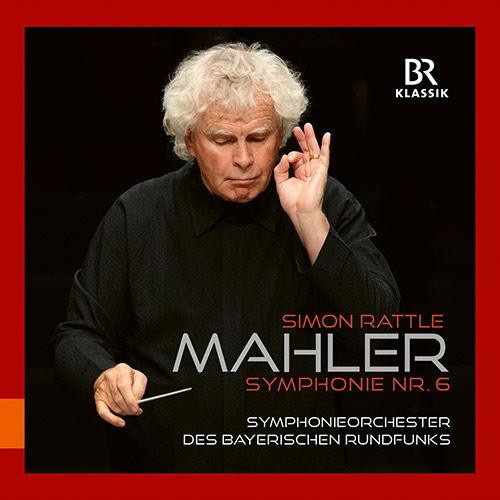
| Among Simon Rattle’s first concert programmes as the new chief conductor of the Bavarian Radio Symphony Orchestra was Gustav Mahler’s Sixth Symphony. The performances marked the beginning of a new chapter in Mahler interpretation, for Rattle, like his predecessors Jansons, Maazel and Kubelík, is an ardent admirer of the composer. BR-KLASSIK has now released the live recording of the concerts. Gustav Mahler’s Sixth Symphony is perhaps the darkest work he ever wrote – its nickname is "The Tragic". And there is something almost destructive about the final movement. "But strangely enough," says Simon Rattle, "it is also a very classical symphony. Yes, it is extreme, but for long stretches it is less wild than other works of his – although of course it does convey a harrowing message. But it’s like a lot of great works: there are always different ways of reading them. I’ve been conducting the Sixth for forty years now, and over time I’ve come to realise that it also contains hope." Mahler composed his Sixth Symphony during the summers of 1903 and 1904 at his "composer’s cottage" in Maiernigg, near Klagenfurt. At the Vienna performance in 1907 (the third under his baton), he called it the "Tragic Symphony" – a nickname that soon became the stuff of legend. In particular, the darkness and devastating hopelessness of the finale – written at a time when he was at the high point of his life, both professionally and personally – are puzzling. Even his wife Alma could not quite explain the contradiction. As always, it was in and through music that Mahler came to terms with his experiences, exploring themes such as farewell, the meaning of existence, death, redemption, the afterlife, and love. More than other Mahler works, the Sixth Symphony is committed to "classical" symphonic form: it is in four movements and has no vocal parts. Despite all the liberties it takes, the opening movement follows sonata form. The Andante draws on the rondo form, as do the Scherzo and the Finale. The march, which sets the tone from the very first note of the first movement, plays a major role. Very unusually, even the Scherzo has march-like features and seems like a parodistic paraphrase of the opening, with a change of perspective. Simon Rattle concludes: "I think Mahler presents here the whole package of a colossal life – and that includes love and optimism."
01. Symphony No. 6 in A Minor Tragic I. Allegro energico, ma non troppo. Heftig, aber markig |
商城正版 高端厂牌 数字专辑
原生高解析数字专辑
信息量可达CD的6.5至512倍。
*384kHz及22.6MHz的高解析音频对设备要求较高
*其中45.2MHz的音频 单曲 可达3g,对存储介质也有较高需求
原生高解析数字专辑
信息量可达CD的6.5至512倍。
*384kHz及22.6MHz的高解析音频对设备要求较高
*其中45.2MHz的音频 单曲 可达3g,对存储介质也有较高需求
声明:本站所有文章,如无特殊说明或标注,均为本站原创发布。任何个人或组织,在未征得本站同意时,禁止复制、盗用、采集、发布本站内容到任何网站、书籍等各类媒体平台。如若本站内容侵犯了原著者的合法权益,可联系我们进行处理。