
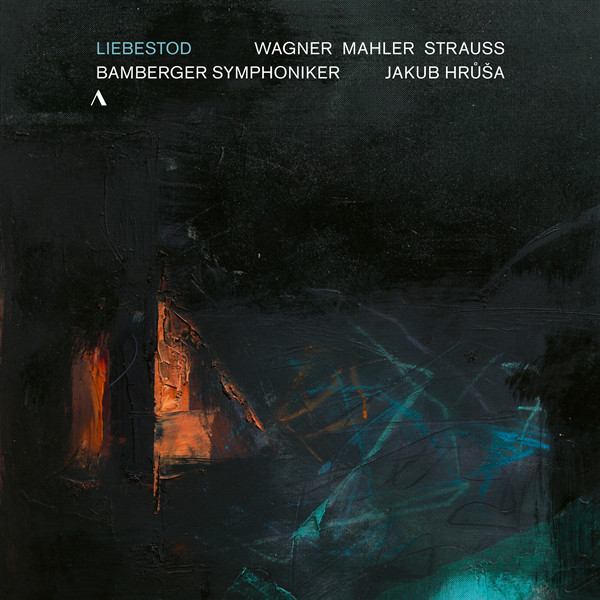
| Don’t let the redundancy of much of this album’s repertoire dissuade you. On all the vital metrics, Liebestod delivers
Programmatically, the Bamberger Symphoniker’s new album with music director Jakub Hrůša doesn’t suggest too many surprises. The fare is strictly canonical. Its dual themes, love and death, as stereotypically Romantic as they come. Yet the performances here are anything but sleepy and the lineup of works by Richard Wagner, Gustav Mahler, and Richard Strauss is a smart one, indeed. That the Prelude and Liebestod from Wagner’s Tristan und Isolde leads things off is almost to be expected. In each, the Bamberger’s playing here offers beauty and tonal lushness, though the former, surprisingly, comes over a bit tamely at its apex. Regardless, the Liebestod’s delicate textures shimmer like ice crystals hanging in air and its apotheosis is radiant. Mahler’s Totenfeier, the original version of the first movement of his Symphony No. 2, follows. While the revisions later made to the score are small (mostly pertaining to issues of texture and instrumentation), it’s fascinating to hear the original conception of this music played with the energy and resplendency Hrůša draws from his forces here. To be sure, theirs is a traversal that beautifully balances rhythmic tautness with moments of songful repose. Likewise ear-catching is their account of the Adagietto from Mahler’s Fifth Symphony. In terms of tempo, this reading takes a middle ground, coming in just under ten minutes in duration. Yet the whole thing feels to be moving with utter naturalness and the transparency of its textures – all of the movement’s moving lines speak – is compelling. Much the same is true of the disc’s closer, Tod und Verklärung. Again, direction and clarity are the rule: the slow introductory section unfolds with richness and fluency. Meanwhile, the furious Allegro is marvelously lucid, but never at the expense of the intensity of the line. Hrůša’s ear for detail reveals much: the string triplets in the middle sparkle, the transition into the “tranquillo” statement of the verklärung theme shimmers, the final peroration is at once blazing and intensely balanced. The end result is a Strauss interpretation that’s as fervent and luminously attractive as they come. Bottom line: don’t let the redundancy of much of this repertoire dissuade you. On all the vital metrics, Liebestod delivers. Jonathan Blumhofer is a composer and violist who has been active in the greater Boston area since 2004. His music has received numerous awards and been performed by various ensembles, including the American Composers Orchestra, Kiev Philharmonic, Camerata Chicago, Xanthos Ensemble, and Juventas New Music Group. Since receiving his doctorate from Boston University in 2010, Jon has taught at Clark University, Worcester Polytechnic Institute, and online for the University of Phoenix, in addition to writing music criticism for the Worcester Telegram & Gazette. 01. Bamberger Symphoniker – Prelude |
原生高解析数字专辑
信息量可达CD的6.5至512倍。
*384kHz及22.6MHz的高解析音频对设备要求较高
*其中45.2MHz的音频 单曲 可达3g,对存储介质也有较高需求