
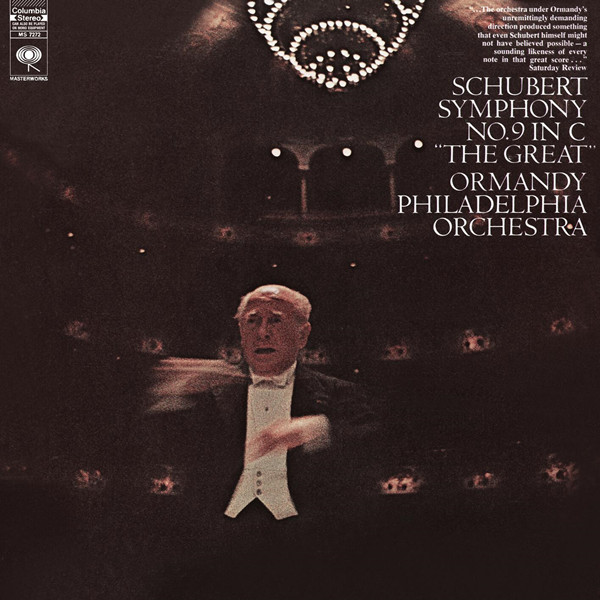
| Excellent version of the Great C Major. The orchestra has the typical sound engineering for Philadelphia in the ’60’s, which means that it is up close and analytical, but also beautiful sounding. Ormandy’s direction is middle of the road, doesn’t provide the tension or the climaxes of say, Furtwangler, Kempe, or Karajan, but at the same time it is not slack or timid, the climaxes in the outer movements are fine, and the attack at the beginning of the Scherzo will surprise you. The Adagio and the trio in the Scherzo are high points.
Two possible drawbacks is that the aesthetic in American recordings of the era was towards up close analysis, so that you could hear all the individual voices (instruments). Few European recordings sound like this, they tend more towards an integrated sound. Compared to that, American recordings, including Ormandy, can seem a bit vulgar. There’s also the issue with Ormandy’s brass, which tends to sound somewhat Broadway (but not in this piece.) The other possible problem is that there are no accelerations/slowdowns that can grab you, as in the transition to the allegro in the first movement (Furtwangler, Kempe), no big surprises (Furtwangler’s big ritard at the end of the first movement), and no hysterical buildup of tension (Karajan’s EMI version, first movement, violins towards coda). It’s not a weak recording, just not a great one. But still excellent. 01. Eugene Ormandy – Symphony No. 9 in C Major, D. 944 The Great I. Andante – Allegro ma no |
原生高解析数字专辑
信息量可达CD的6.5至512倍。
*384kHz及22.6MHz的高解析音频对设备要求较高
*其中45.2MHz的音频 单曲 可达3g,对存储介质也有较高需求