
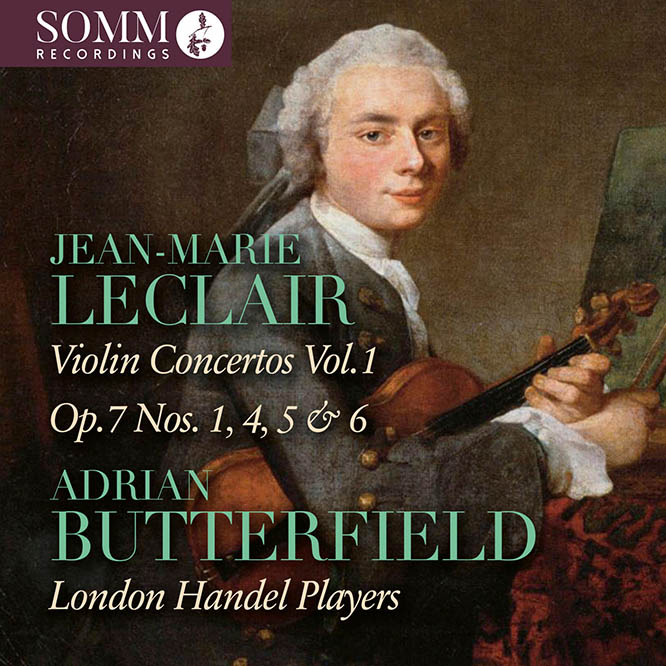
| 01. Violin Concerto No. 5 in A Minor, Op. 7 No. 5: I. Vivace 02. Violin Concerto No. 5 in A Minor, Op. 7 No. 5: II. Largo 03. Violin Concerto No. 5 in A Minor, Op. 7 No. 5: III. Allegro assai 04. Violin Concerto No. 4 in F Major, Op. 7 No. 4: I. Allegro moderato 05. Violin Concerto No. 4 in F Major, Op. 7 No. 4: II. Adagio 06. Violin Concerto No. 4 in F Major, Op. 7 No. 4: III. Allegro 07. Violin Concerto No. 1 in D Minor, Op. 7 No. 1: I. Allegro 08. Violin Concerto No. 1 in D Minor, Op. 7 No. 1: II. Aria. Grazioso 09. Violin Concerto No. 1 in D Minor, Op. 7 No. 1: III. Vivace 10. Violin Concerto No. 6 in A Major, Op. 7 No. 6: I. Allegro ma non presto 11. Violin Concerto No. 6 in A Major, Op. 7 No. 6: II. Aria. Grazioso non troppo adagio 12. Violin Concerto No. 6 in A Major, Op. 7 No. 6: III. Giga. Allegro SOMM Recordings is delighted to build upon its critically acclaimed discography with violinist, Adrian Butterfield, and the London Handel Players in a new collaboration featuring the Op. 7 set of six Violin Concertos by the French violinist-composer, Jean-Marie Leclair. The London Handel Players, praised by the New York Times for their “soulful depth” and “consummate skill and musicianship,” have previously released five Handel discs with SOMM, along with recordings that celebrate Geminiani, J.S. Bach, and Telemann. The group’s co-founder and director, period-instrument violinist Adrian Butterfield, has been described as “a marvel” by Gramophone for his recordings of Leclair’s first three books of violin sonatas. The solo concerto emerged in Italy in the early 18th century through composers like Torelli, Albinoni and, particularly, Vivaldi. J.S. Bach acquired a copy of Vivaldi’s popular set of twelve concertos, L’Estro Armonico, to transcribe and study, and he put his own stamp on concerto writing with works that are larger in scale, making use of more detailed contrapuntal development and a greater degree of harmonic variety. When Jean-Marie Leclair met an untimely death on 23 October, 1764 in a still-unsolved murder in Paris, he left behind a stellar reputation as the founder of the French violin school, along with a collection of works for violin that includes four volumes of solo violin sonatas and two volumes of violin concertos; his Op. 7, heard here, and Op. 10, to follow in the near future. These virtuosic and elegant violin concertos are something of an amalgam of the Italian concerto style and of Bach’s formalistic innovations. Leclair was born in Lyon in 1697, and his dream was to become a solo violinist in his own country. But, at this time in France, violin playing was the province of country fiddlers and orchestral players, while the viol was the chosen instrument for the French upper classes. When the Italian violinist-composer, Arcangelo Corelli, published his iconic set of Op. 5 sonatas in 1700, no French violinist was equipped with the technique to perform them. Having spent a year studying dance and composition in the Italian city of Turin, Leclair moved to Paris, where he soon published his first set of twelve violin sonatas. For a couple of years, he commuted between Paris and Turin in order to study with a former student of Corelli’s, and, over the course of two decades, published three more sets of sonatas, along with the two sets of violin concertos. The concertos are justly celebrated for their blend of French elegance and Italian virtuosity, reflecting not only Leclair’s skill as a renowned violinist, but also his background, which drew on a variety of Europe’s national styles. |
原生高解析数字专辑
信息量可达CD的6.5至512倍。
*384kHz及22.6MHz的高解析音频对设备要求较高
*其中45.2MHz的音频 单曲 可达3g,对存储介质也有较高需求