
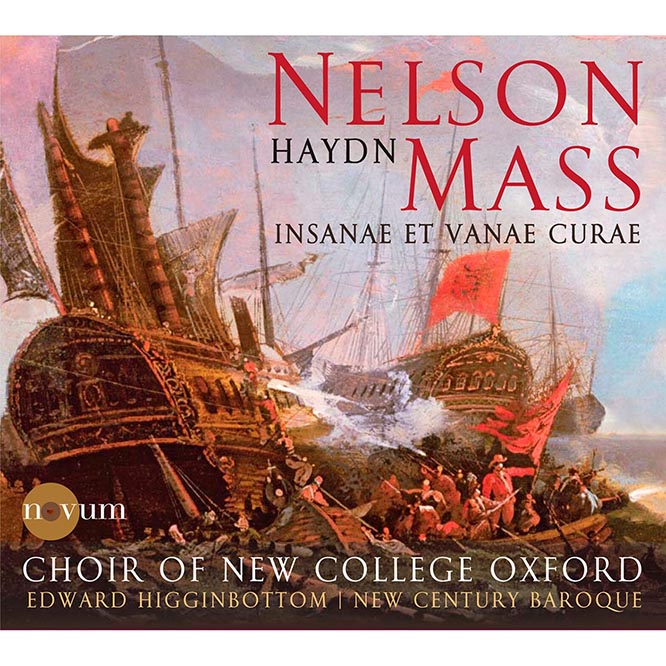
| 01. Mass No. 11 in D minor, Hob.XXII:11, “Nelsonmesse”, “Imperial Mass”, “Coronation Mass”: Kyrie 02. Mass No. 11 in D minor, Hob.XXII:11, “Nelsonmesse”, “Imperial Mass”, “Coronation Mass”: Gloria: Gloria in excelsis Deo 03. Mass No. 11 in D minor, Hob.XXII:11, “Nelsonmesse”, “Imperial Mass”, “Coronation Mass”: Gloria: Qui tollis peccata mundi 04. Mass No. 11 in D minor, Hob.XXII:11, “Nelsonmesse”, “Imperial Mass”, “Coronation Mass”: Gloria: Quoniam tu solus sanctus 05. Mass No. 11 in D minor, Hob.XXII:11, “Nelsonmesse”, “Imperial Mass”, “Coronation Mass”: Credo: Credo in unum Deum 06. Mass No. 11 in D minor, Hob.XXII:11, “Nelsonmesse”, “Imperial Mass”, “Coronation Mass”: Credo: Et incarnatus est 07. Mass No. 11 in D minor, Hob.XXII:11, “Nelsonmesse”, “Imperial Mass”, “Coronation Mass”: Credo: Et resurrexit 08. Insanae et vanae curae 09. Mass No. 11 in D minor, Hob.XXII:11, “Nelsonmesse”, “Imperial Mass”, “Coronation Mass”: Sanctus 10. Mass No. 11 in D minor, Hob.XXII:11, “Nelsonmesse”, “Imperial Mass”, “Coronation Mass”: Benedictus 11. Mass No. 11 in D minor, Hob.XXII:11, “Nelsonmesse”, “Imperial Mass”, “Coronation Mass”: Agnus Dei: Agnus Dei 12. Mass No. 11 in D minor, Hob.XXII:11, “Nelsonmesse”, “Imperial Mass”, “Coronation Mass”: Agnus Dei: Dona nobis pacem Novum continues to celebrate the magnificent work of New College Choir – in the classics of the choral repertory, and in its byways. Here, in Haydn’s Nelson Mass, they tackle one of the most frequently climbed summits in the choral range. The metaphor is not misplaced: the work makes high demands on singers and orchestra alike, not least in the coloratura writing for the solo soprano (here sung brilliantly by the leading treble), and the virtuoso string writing (delivered with youthful panache by New Century Baroque). These qualities give the New College performance an unusual lustre and presence. The Mass is coupled with Haydn’s ever-popular motet Insanae et vanae curae. The scoring used in this new recording is Haydn’s original primary-coloured orchestration for strings and trumpets. This brings to the performance an arguably more characterful sound-world than when the woodwinds are employed (after the first edition by Breitkopf & Härtel). In addition, we source the solo voices from the Choir, making the vocal ensemble fully cohesive with the chorus. This makes complete sense for the alto, tenor and bass soloists, whose technical demands are no more exacting that the chorus parts. But it raises questions for the soprano solo part, written for a singer of a very different cut. Here, New College sticks to its belief in the capacity of boys (some boys at least) to measure up to the highest demands of vocal artistry. You won’t find another recording which so fully celebrates the capacity of a boys’ choir to scale this particular summit. The motet Insanae et vanae curae, contemporary with the Mass, and occupying the same dramatic world, is sung as an Offertory motet. The scoring of the motet has been adapted to the scoring of the Mass: woodwinds have been excised and in their place the organ (as in the Nelson Mass) provides the figurations otherwise lost. “This latest account…is less punchy, more liturgical than some, but scarcely less intent in purpose. Instead of the usual operatic soloist in the florid solo soprano passages, we have a remarkably secure and expressive boy treble in Jonty Ward, while the Choir of New College sing with all their usual focus.” (BBC Music Magazine) “Many excellent recordings abound but none has such a particular drawing points as on the disc released here, which features the treble Jonty Ward singing the soprano solos. His tone is warm and even, with a hint of a ‘continental’ flavour. His tuning is spot-on throughout…this is a polished disc of great music and deserves to be widely heard.” (Gramophone Magazine) |
原生高解析数字专辑
信息量可达CD的6.5至512倍。
*384kHz及22.6MHz的高解析音频对设备要求较高
*其中45.2MHz的音频 单曲 可达3g,对存储介质也有较高需求