
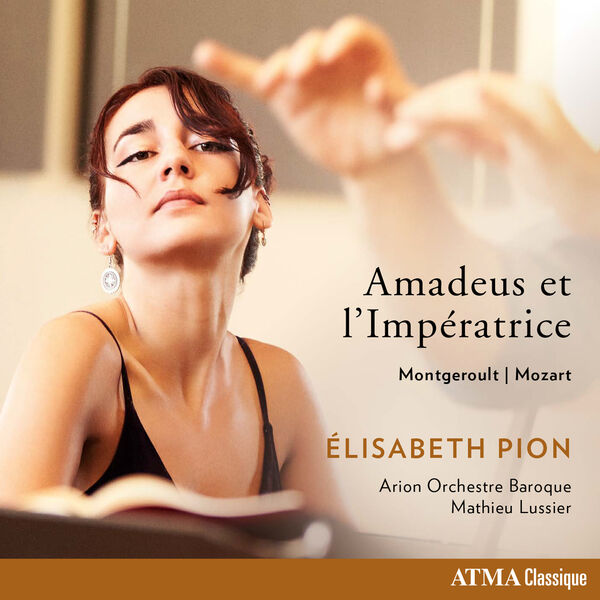
| After releasing her first album, Femmes de légendes, Saint-Hyacinthe born pianist Élisabeth Pion, who was named Révélation Radio-Canada 2024-2025 in classical music, once again puts the work of women composers at the heart of her artistic approach. Her second album is dedicated to a grande dame of French piano, Hélène de Montgeroult, whom she opposes to Mozart. One of the few aristocrats to have been spared by the French Revolution, and the only woman to have passed the competitive examination to become professor of the first piano classes at the Paris Conservatoire, Montgeroult’s musical language is imbued with the palette of Mozart’s classicism, but with some experimentation that calls to mind the beginnings of Romanticism. This heritage is perceptible in the Concerto for Pianoforte No. 1 in E-flat major (after Giovanni Battista Viotti). The energetic first movement recalls Mozart’s vivacity in its lines and orchestration. The second movement has a melodic contour of great lyricism, reminiscent of Chopin, but without the melancholic flights of the Preludes or Nocturnes, while the third movement is resolutely Beethovenian in character, with its bouncing strings and the place it gives to the piano, as in The Emperor.
This emphasis takes on its full meaning when we listen to Mozart’s Concerto for Pianoforte No. 24, composed around the same time as Montgeroult’s work. This allows us to compare the two languages, and to see the versatility and breadth of Montgeroult’s language. Elements of the language of the woman called “L’Impératrice” by her admirers are displayed in a musically embodied way by Elisabeth Pion, who masters the dynamics and sound architecture of the repertoire with dexterity, particularly in the studies taken from Montgeroult’s important pedagogical work, which reveal the technicality of her writing. Playing on a Broadwood 1826 forte-piano, loaned by patron Jacques Marchand, the sound is woodier and less resonant than on modern pianos, allowing greater agility than a harpsichord and reinforcing the “historically informed” spirit that runs through the album. At every moment, Élisabeth Pion’s delicate, lively touch and agile, sensitive playing blends with the resonant timbre of the orchestra conducted by Mathieu Lussier to deliver a regal opus. jeu agile et senti d’Élisabeth Pion se marient au timbre résonnant de l’orchestre dirigé par Mathieu Lussier pour livrer un opus royal. 01. I. Allegro |
原生高解析数字专辑
信息量可达CD的6.5至512倍。
*384kHz及22.6MHz的高解析音频对设备要求较高
*其中45.2MHz的音频 单曲 可达3g,对存储介质也有较高需求